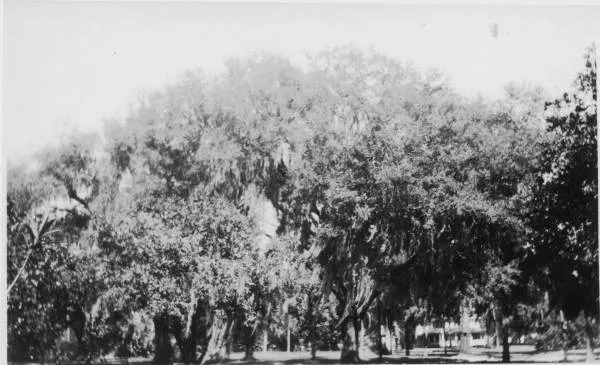
Twelve acres of open water on the southern edge of downtown Orlando. Live oaks dripping Spanish moss along the brick streets. A century and a half of residents — bankers, suffragists, architects, builders, schoolteachers, and the ordinary families in between — who built and rebuilt the neighborhood we live in today. This is some of what is publicly known.
The lake’s names
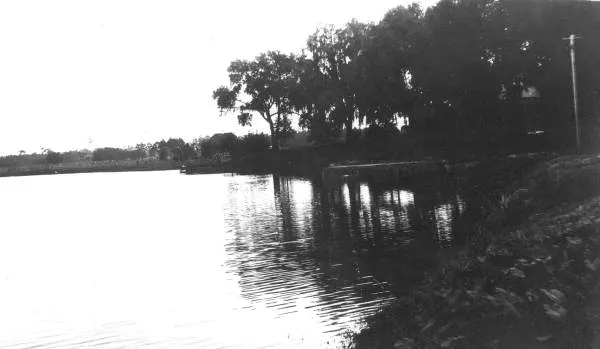
The lake has carried three names. The earliest recorded name was Lake Eva, after a member of the Lee family. In the early 1870s, John Poyntz married Minnie Hall — daughter of early Orlando settler Dr. Fergus Sloan Hall — and the couple built the first house on the lake’s western shore. The lake took Minnie’s name and became Lake Minnie. The name Lake Cherokee came later; the precise date of that renaming is not in current sources, though the name was established by the time Cherokee School opened under it in 1927.
John’s brother Oliver Poyntz married Minnie’s sister Fannie Hall and built next door. The two Poyntz–Hall couples seeded the cluster of newlywed homes that became known as Honeymoon Row.
Honeymoon Row
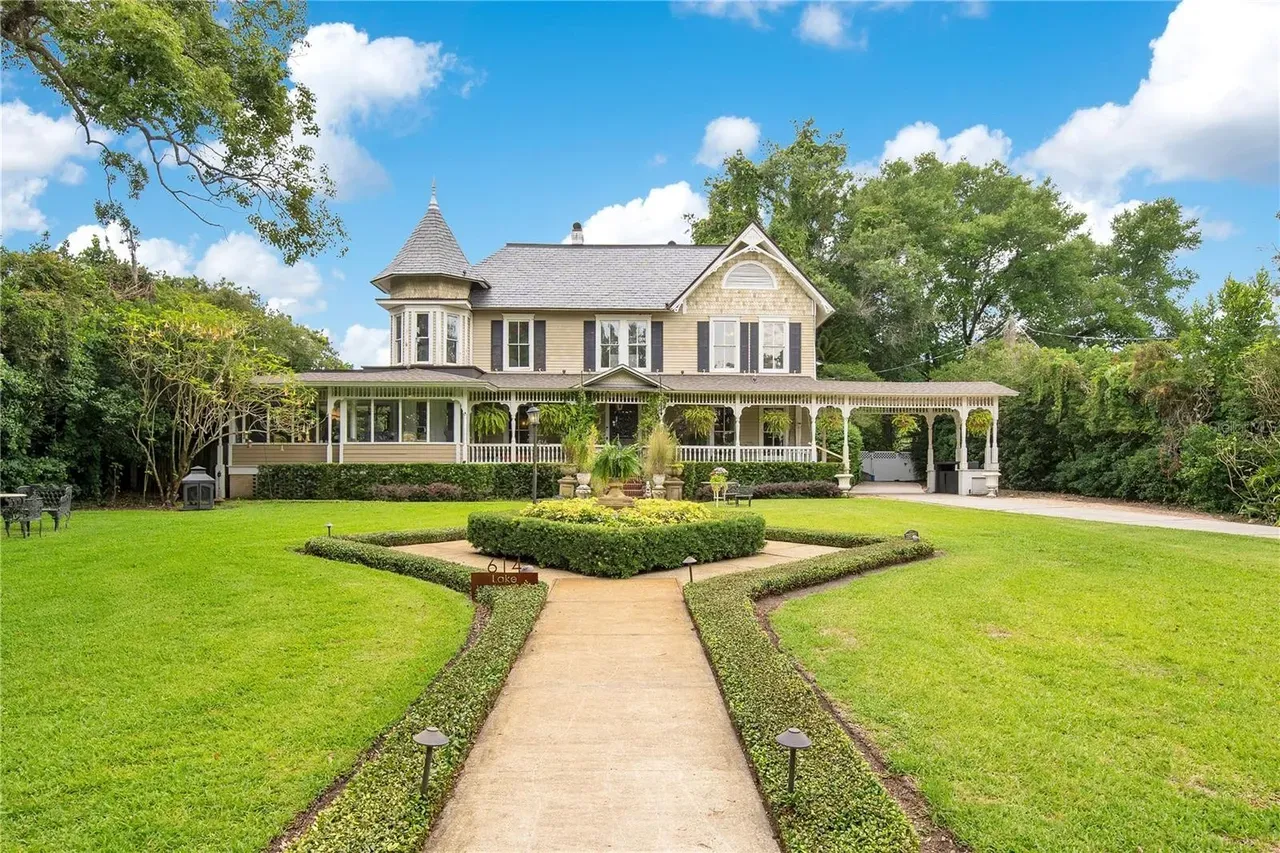
The Poyntz-O’Neal House at 614 South Lake — the northernmost of the original Honeymoon Row homes, built in 1887 by banker Oliver T. Poyntz.
Through the 1880s, a cluster of newlywed homes rose along the west shoreline. The small enclave became known as Honeymoon Row; sources count five to six homes. Three of the documented ones were razed in the decades that followed, before historic-district protection arrived in 1981: the Cheney/Odlin House (demolished 1915), the Weeks House (1944), and the Newell House (1975, for a townhouse complex, over an unsuccessful block attempt by City Commissioner George Stuart Jr.). Two survive:
- Poyntz-O’Neal House (1887) — 614 South Lake. Queen Anne style, the northernmost of the row, built by banker Oliver T. Poyntz for himself and Matilda Poyntz.
- Gunby House (1887) — 709 Euclid Avenue.
Jessie O’Neal and the first suffrage meeting
In 1914 the Poyntzes sold the house at 614 South Lake to Jessie Annie Mallory — soon to marry William Russell O’Neal, the Orlando civic figure whose name the house also carries. Jessie was a nationally recognized women’s-club leader and President of the Florida Equal Suffrage Association.
A year before her marriage, in February 1913, Jessie convened the first meeting of an Equal Suffrage League in Orlando in the parlor of that house — Central Florida’s first organized push for women’s voting rights. The notice that ran in the Orlando Sentinel was co-signed by Mary P. Patterson and Mary Safford, who would become Central Florida’s best-known suffrage leader.
In March 1919, Orlando passed a municipal ordinance enabling women to vote in city elections — over a year before the 19th Amendment was ratified nationally. The following month, after the Florida House affirmed the right, Jessie celebrated by marching around Lakes Cherokee and Lucerne waving an American flag and ringing a bell. She died at the house in 1923, age 60.
How the Poyntz-O’Neal House survived
In the 1970s the Poyntz-O’Neal House faced demolition. Twelve families collectively bought the property to save it — an act of neighborhood preservation that is widely credited as a catalyst for the Lake Cherokee Historic District designation a few years later. The house was named a local landmark in 1977; the district as a whole was designated in July 1981.
A pop-culture footnote: D.A.R.Y.L. (1985)
The Poyntz-O’Neal House makes an appearance near the beginning of the 1985 science-fiction film D.A.R.Y.L., and Lake Cherokee itself is the setting for the splashdown scene near the film’s end. Two principal residential houses in the film — Daryl’s house and Turtle’s house — are at 716 and 717 Euclid Avenue, both inside the historic district. The film’s broader “Barkenton” geography also used Lake Copeland, Delaney Park, and Kaley School.
The 1920s land boom
The 1920s Florida land boom transformed the neighborhood. A wide range of architectural styles arrived along the streets north and west of the lake — Craftsman bungalows, Tudor Revival, Mediterranean Revival, and Colonial Revival homes, alongside Minimal Traditional forms. A few notable groupings:
- Hovey’s Court — 545 Delaney Avenue. Nine bungalows built between 1913 and 1919, all facing each other to form a small inner courtyard. Originally guest cottages for visitors to the city.
- The Phillips family homes — the Peleg Peckham-Dr. Phillips House (1893) at 135 North Lucerne Circle East represents the late-Victorian moment; decades later Wellborn Phillips built the Wellborn Apartments (1947) in the neighborhood, an Art Deco building with sixteen units cleverly positioned so that almost every living room has a view of the lake.
Cherokee School (1926–1927)
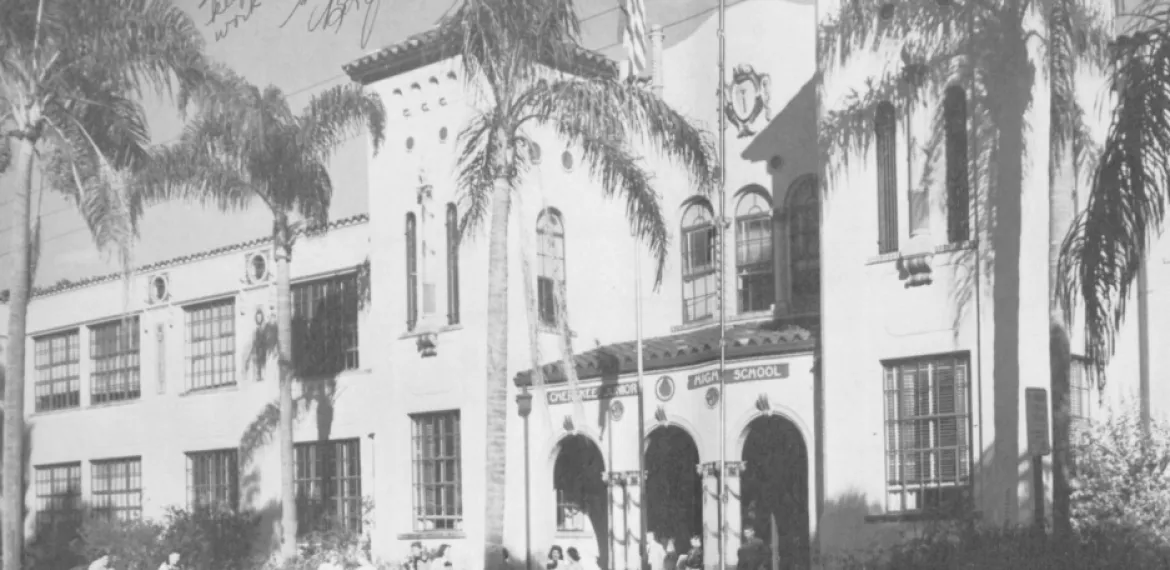
Cherokee Junior High School not long after its 1927 opening. The Mediterranean Revival facade — arched entryways, terracotta detailing, the ceramic torches and stone owls — was intentional civic architecture for what the Orlando Sentinel called one of the “finest and most magnificent” schools in the South.
In August 1926 the Orange County Board of Public Instruction paid $120,000 for the Smith-Compton property — two lots in Block 6 of the F. T. Poynter Addition to Orlando — to build a junior high school for the residential district that had grown up around the lake. James Petersen Construction Co. won the contract with a low bid of $304,500; the building was designed by Orlando architect Howard M. Reynolds in the Mediterranean Revival style, wrapped around an open central court with a 1,000-seat auditorium and a separate gymnasium. It opened for its first class in 1927 as Cherokee Junior High School.
The school has carried the neighborhood’s civic story across the century since; the building has stood vacant since 2021.
Notable residents
| Name | Years | Role |
|---|---|---|
| John Poyntz & Minnie Hall Poyntz | early 1870s + | Lake’s first lakefront settlers; lake renamed for Minnie |
| Oliver T. Poyntz & Matilda Poyntz | 1887 + | Built the Poyntz-O’Neal House — northernmost of Honeymoon Row |
| William Russell O’Neal | 1914 + | Orlando civic figure: banker, bookseller, postmaster, acting mayor, City Council president, Rollins College trustee, journalist |
| Jessie Mallory Thayer O’Neal | 1914 – 1923 | President, Florida Equal Suffrage Association; convened Central Florida’s first suffrage meeting in her Lake Cherokee parlor (Feb 1913) |
| Howard M. Reynolds | 1926 + | Architect; designed Cherokee School in the Mediterranean Revival style |
| Wellborn Phillips | 1947 + | Built the Wellborn Apartments (Art Deco, sixteen units, lake views) |
This list is the start of the record, not the whole of it. The 12 families who bought the Poyntz-O’Neal House in the 1970s to save it — whose preservation work catalyzed the district designation — belong on the list; their names will be added as the record gets filled out.
Historic district designation (1981)
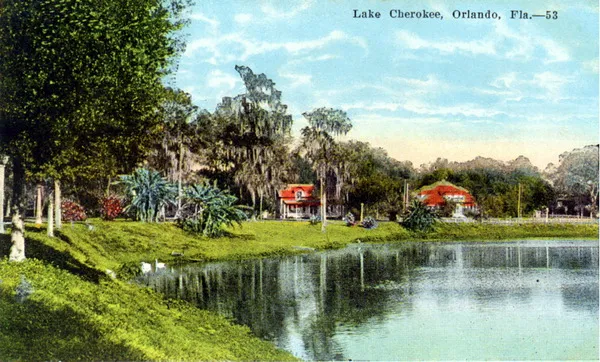
In July 1981, the City of Orlando designated the Lake Cherokee Historic District — its second locally-designated historic preservation district, following Downtown (1980). Per the City, the district covers 16 square blocks containing 189 buildings, of which 160 are contributing structures. The designation criteria considered:
- Citizen involvement — the 1970s Poyntz-O’Neal preservation effort is the most visible example.
- Architectural significance of the area’s buildings.
- The neighborhood’s contributions to Orlando’s cultural heritage.
A year after the local designation, in 1982, the district was specially certified by the U.S. Secretary of the Interior — making contributing properties eligible for a 20 % Federal Historic Rehabilitation Tax Credit. The City of Orlando also offers a 10-year property tax exemption on the City’s portion of any tax increase attributable to substantial rehabilitation. (Practical information about both incentives is on the Resources page.)
Orlando has six historic preservation districts today; Lake Cherokee was the second:
| District | Local designation |
|---|---|
| Downtown | 1980 |
| Lake Cherokee | July 1981 |
| Lake Copeland | 1984 |
| Lake Eola Heights | 1989 |
| Lake Lawsona | 1994 |
| Colonialtown South | 2000 |
Photo archive
Several historic photographs of Lake Cherokee and the neighborhood are publicly available through state and local archives. A handful of starting points:
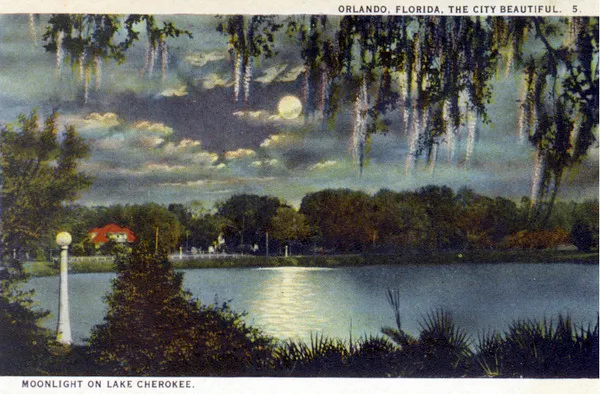
- Florida Memory — State Archives of Florida; historical photographs of Lake Cherokee, including the 1915 lake view and 1923 “Moonlight on Lake Cherokee” used above. Search “Lake Cherokee Orlando.”
- Orange County Regional History Center — downtown Orlando museum with primary-source records for Central Florida history; the most likely source for the parcel-by-parcel residential record, Cherokee School use timeline, and Honeymoon Row’s original homeowners.
- Florida Memory — “View of Lake Cherokee” (1915) — the source for the 1915 photograph used in this page.
Sources
- City of Orlando — Historic Preservation Districts (district boundaries, building counts, designation criteria, rehab incentives).
- The Craftsman Blog — Orlando Historic Districts: Lake Cherokee (lake-naming sequence, Hovey’s Court, Wellborn Apartments, Honeymoon Row context).
- Orlando Magazine — “Explore Orlando’s First Historic Home on Lake Cherokee” (Poyntz-O’Neal House provenance, Jessie O’Neal suffrage history, 12-families preservation story, D.A.R.Y.L. footnote).
- The Lucas Countyan — “Jessie Mallory Thayer O’Neal and woman’s suffrage” (full Jessie O’Neal biography and the 1919 suffrage marches).
- Wikipedia + 80s Movies Rewind — D.A.R.Y.L. (1985) and filming locations (film geography, scene-by-scene locations).
- Florida Memory — State Archives of Florida photographs.
- Our own research notes — every claim on this page was traced to a source before it was written down, and those working notes are on this site so anyone can check them: how the lake got its name, Honeymoon Row, the people who lived here, the 1985 filming, and the historic district itself. Each one opens with the full list of sources it drew on. Found something we got wrong? Tell us.